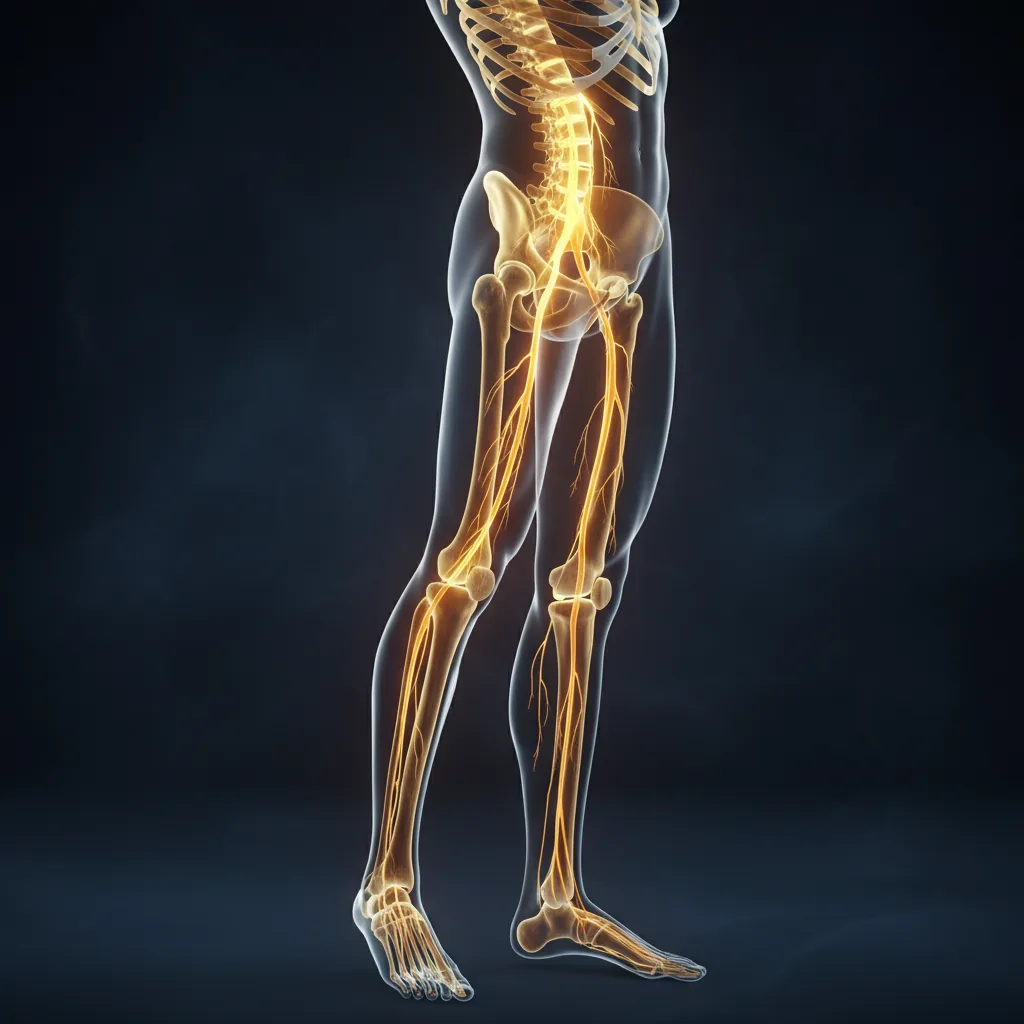
When a patient tells me they have "sciatica," that tells me roughly where the pain is going — down the leg, usually one side, often with burning, tingling, or numbness. What it doesn't tell me is why. And the "why" is where most physical therapy for sciatica falls apart.
Red flags — seek emergency care immediately: Sciatica with sudden bowel or bladder dysfunction, progressive leg weakness (not just pain), or saddle area numbness (inner thighs, perineum) may indicate cauda equina syndrome — a rare but serious emergency requiring immediate evaluation.
What "Sciatica" Actually Means Clinically
When patients say sciatica, they're describing a symptom — radiating leg pain that follows the path of the sciatic nerve. Clinically, this pattern almost always originates from a disc injury, with or without involvement of the nerve root. The distinction matters enormously.
In mild to moderate cases, the disc is inflamed and irritating the adjacent nerve root — causing radicular symptoms down the leg without structural compromise. The nerve is angry, not compressed. This responds well to careful treatment and typically recovers fully with the right approach.
In more severe cases, there's actual nerve root compression — the disc material is physically pressing on the nerve root with enough force to produce neurologic changes. I assess this directly by testing the myotomes (muscle strength patterns) and dermatomes (sensation patterns) associated with each spinal level. Changes here tell me the nerve isn't just irritated — it's being mechanically impinged, which changes the urgency and type of treatment required.
This distinction — irritation vs. compression with neurologic insult — is something a thorough physical therapy examination identifies. It's also something an overloaded, 15-minute insurance-based session frequently misses entirely.
The Neurodynamic Examination: Why It Must Be Tailored
One of the most critical and most commonly overlooked parts of a sciatica evaluation is the neurodynamic examination. This is a set of specific movement tests that place the nervous system under controlled tension — allowing me to assess how the nerve is moving (or not moving) through the surrounding tissue.
Nerves aren't passive structures. They glide, slide, and adapt as you move. After weeks of compression or irritation, a nerve can become adherent to surrounding tissues, losing its ability to move freely along its course. This is why even when a disc heals, some patients continue to have symptoms — the nerve hasn't regained its mobility.
The neurodynamic exam tells me where that restriction is, how irritable the nerve is, and what type of neural mobilization is appropriate. This is what determines whether a patient needs a nerve glide, a nerve tensioner, or something more specific to their anatomy and presentation. The test results are highly individual — which is why the examination must be tailored to each person rather than following a generic protocol.
Three Common PT Errors That Make Sciatica Worse
In my experience, the same three mistakes show up repeatedly in how most therapists manage sciatica — particularly in high-volume, insurance-based settings where there isn't time for a thorough assessment.
Prescribing Neural Mobilization Without Understanding the Anatomy
Nerve glides are a powerful tool — when they're applied correctly. The problem is that many therapists prescribe generic sciatic nerve glides without understanding how nerves actually move through the body, or without having performed a proper neurodynamic assessment first.
The sciatic nerve doesn't move in isolation. It slides relative to surrounding tissue at multiple points along its course — from the nerve root at the spinal level, through the piriformis region, down through the hamstring compartment to the calf. The appropriate mobilization technique depends on where the restriction or irritation actually is, how symptomatic the nerve currently is, and what the patient's neurodynamic test results show. Giving a blanket "sciatic nerve floss" to every patient with leg pain is not treatment — it's guesswork, and it can aggravate an already-irritated nerve root.
The Stretch That Often Makes Sciatica Significantly Worse
This is one I see constantly — and it causes real harm. A patient complains of pain down the back of the leg, and the therapist gives them prolonged hamstring stretches because the leg feels "tight."
The problem: the tightness isn't always a muscle. When a nerve root is irritated, the neural tissue itself can produce the sensation of hamstring tightness — and stretching the hamstring for 30–60 seconds places sustained tension on the entire sciatic nerve from root to foot. This activates what are called Abnormal Impulse Generating Sites (AIGs) — regions along the nerve root that, when irritated, generate abnormal electrical signals in response to mechanical input. Prolonged tension at these sites can dramatically increase nerve root irritability, worsening radiating symptoms for hours or days after the session. The patient was trying to help themselves. The therapist reinforced a pattern that was making them worse.
Prescribing Flexion vs. Extension Without Assessing Directional Preference
Lumbar direction matters enormously in disc-related sciatica. For many patients with a posterolateral disc herniation, extension movements (arching the back) help centralize symptoms — moving pain from the leg back toward the spine, which is a positive prognostic sign. For others, particularly those with foraminal stenosis or lateral herniations, extension narrows the exit space for the nerve root and worsens symptoms.
The error is prescribing one direction without formally assessing which one actually helps each individual patient. This is called directional preference assessment — a systematic process of testing repeated lumbar movements in flexion and extension to see which direction reduces or centralizes symptoms. Without this assessment, a therapist is essentially guessing. Prescribing the wrong direction can provoke significant worsening, and in a rushed setting, that worsening often goes unmonitored until the patient has already set themselves back by weeks.
Not Sure What's Actually Causing Your Sciatica?
A full neurodynamic exam and directional assessment at Solas PT will identify exactly what's happening — and build a treatment plan that doesn't make it worse. No referral needed in Texas.
The Treatment Progression at Solas PT
Once the evaluation is complete and I know what I'm actually dealing with — severity of nerve involvement, directional preference, neurodynamic mobility, movement chain deficits — treatment follows a specific, monitored progression. There's no one-size protocol. But the phases are consistent.
Calm the Nervous System First
The priority in the acute and sub-acute stage is to reduce nerve root irritability before loading the system. This involves manual therapy to the lumbar spine and surrounding tissues, graded neural mobilization based on the neurodynamic exam findings, directional preference exercises tailored to what the assessment revealed, and dry needling to address active trigger points in the muscles surrounding the nerve root when appropriate. Trying to strengthen or stabilize before the nerve has calmed down is like trying to build on a fire — you're just adding fuel.
Load the System Without Provoking It
As symptoms reduce — measured by the distribution of pain centralizing, the neurodynamic tests improving, and the patient's tolerance for activity increasing — we begin progressive core stabilization. This starts with deep stabilizer activation (transverse abdominis, multifidus) and advances to loaded functional movements. The key is monitoring. Every exercise is assessed for symptom response. If a movement provokes radiating symptoms, we modify it — we don't push through, and we don't back off entirely. We find the appropriate load and build from there.
Rebuild What the Injury Took Away
The final phase bridges from clinical rehab back to whatever the patient's real life demands — whether that's sitting at a desk for eight hours, training at the CrossFit gym, or returning to a physical job. This is where exercise prescription gets sport- and activity-specific: loaded carries, hinge patterns, overhead work, running mechanics, whatever the patient needs. The goal isn't pain-free in the clinic — it's fully capable outside of it.
Why This Requires Week-by-Week Monitoring
Sciatica involving nerve root irritation or compression is one of the conditions that genuinely requires careful, ongoing clinical judgment — not a protocol handed to a patient and executed unsupervised.
The neurodynamic presentation changes week to week. A mobilization that was appropriate in week two may be too aggressive in week three if the nerve is more reactive. The directional preference can shift as the disc heals. The appropriate load for core stability progresses — and should be progressed by someone who is evaluating the current response, not someone following a predetermined sheet.
In a high-volume insurance-based setting, where a therapist may be managing five or six patients simultaneously, this level of attention is structurally impossible. Patients are handed exercise sheets and supervised by aides. The kind of monitoring that actually prevents setbacks — catching when a patient is about to push too hard, recognizing when the nerve is getting more irritable, adjusting the direction or load before symptoms worsen — requires being present and attentive for the full session.
At Solas PT, every session is one-on-one with me. I'm assessing the response, adjusting in real time, and progressing the program based on what I observe — not on what a protocol says should happen by week four. For sciatica, that difference in attention directly determines whether a patient recovers in six weeks or continues to cycle through flare-ups for six months.
No referral needed — direct access PT in El Paso
Texas allows direct access to physical therapy without a physician referral. Dr. Cisneros evaluates, diagnoses, and treats — including neurodynamic assessment, directional preference testing, dry needling, and progressive rehabilitation — all without requiring a referral first. Same-week appointments available.
Frequently Asked Questions
No — sciatica is a symptom description, not a clinical diagnosis. It describes radiating pain along the path of the sciatic nerve, but the underlying cause can be a disc herniation, nerve root irritation, foraminal stenosis, or piriformis-related compression. Each has a different examination finding, different treatment approach, and different prognosis. Treating "sciatica" without identifying which mechanism is driving it is why so many patients get the wrong exercises and make limited progress.
No. Most sciatica is accurately diagnosed through a clinical examination — neurodynamic testing, myotome and dermatome assessment, directional preference testing, and movement analysis. In Texas, you can see a physical therapist directly without a physician referral or imaging. If imaging is clinically indicated — for example, if there are progressive neurologic changes or the presentation doesn't respond as expected — Dr. Cisneros will refer you appropriately.
This is more common than most people realize. When a nerve root is irritated, the sensation of hamstring tightness is often coming from the neural tissue — not the muscle itself. Prolonged hamstring stretching places sustained tension on the entire sciatic nerve from the root to the foot, which can activate Abnormal Impulse Generating Sites (AIGs) along the nerve root and significantly increase irritability. The result is more radiating symptoms, not less. A proper neurodynamic assessment identifies whether stretching is safe and in what form — rather than applying it generically to every patient with leg pain.
With the right treatment approach, most cases of disc-related sciatica with nerve root irritation show meaningful improvement within 6–10 sessions. Cases with actual nerve root compression and neurologic changes may take longer and require more careful monitoring. The biggest factor in recovery time is getting the diagnosis right early — patients who spend weeks on the wrong exercises (wrong direction, inappropriate neural loading) often extend their recovery by months. Early, accurate assessment shortens the timeline significantly.
Every session is one-on-one with Dr. Cisneros — no aides, no cookie-cutter protocol. Sciatica treatment at Solas PT includes a full neurodynamic examination, directional preference assessment, myotome and dermatome testing, and a treatment plan that's adjusted every session based on how the nerve is responding. Dry needling and electrodry needling (dry needling with TENS stimulation) are available when clinically indicated. The week-by-week monitoring that sciatica genuinely requires is built into how every session is structured — not something extra.
Yes, when used correctly as part of a complete treatment approach. Dry needling is particularly effective for reducing trigger point activity in the muscles surrounding the nerve root — the paraspinals, piriformis, and glutes — which can reduce the compressive environment the nerve root is living in. At Solas PT, Dr. Cisneros also uses electrodry needling (TENS delivered through the needles) for more chronic or treatment-resistant cases, which amplifies the neuromuscular response and produces longer-lasting relief. Dry needling is never used as a standalone treatment for sciatica — it's one component of a complete plan.
No — but the type of exercise matters enormously. Complete rest worsens sciatica by deconditionong the muscles that support the spine and increasing neural sensitization. The goal is graded, monitored activity that loads the system appropriately without provoking the nerve. Walking is almost always safe and beneficial. What to avoid, in the early stages, is unsupervised loaded exercise, prolonged forward bending, and sustained positions that increase leg symptoms. As irritability decreases, activity is progressively reintroduced under clinical guidance.
No. Most sciatica is accurately diagnosed through a clinical examination — neurodynamic testing, myotome and dermatome assessment, directional preference testing, and movement analysis. In Texas, you can see a physical therapist directly without a physician referral or imaging. If imaging is clinically indicated — for example, if there are progressive neurologic changes — Dr. Cisneros will refer you appropriately.
Every session is one-on-one with Dr. Cisneros — no aides, no cookie-cutter protocol. Treatment includes a full neurodynamic examination, directional preference assessment, myotome and dermatome testing, and a plan adjusted every session based on how the nerve is responding. The week-by-week monitoring that sciatica genuinely requires is built into how every session is structured.
Sciatica Managed Carefully —
Not Guessed At.
If your sciatica isn't improving, or keeps coming back, the treatment approach needs a closer look. Dr. Cisneros will assess the nerve, test the direction, and build a plan that actually matches your presentation. No referral. Same-week appointments in West El Paso.
Book a Sciatica EvaluationAlso read: Lower Back Pain Treatment in El Paso → | Dry Needling: Benefits & How It Works → | Direct Access PT in Texas →