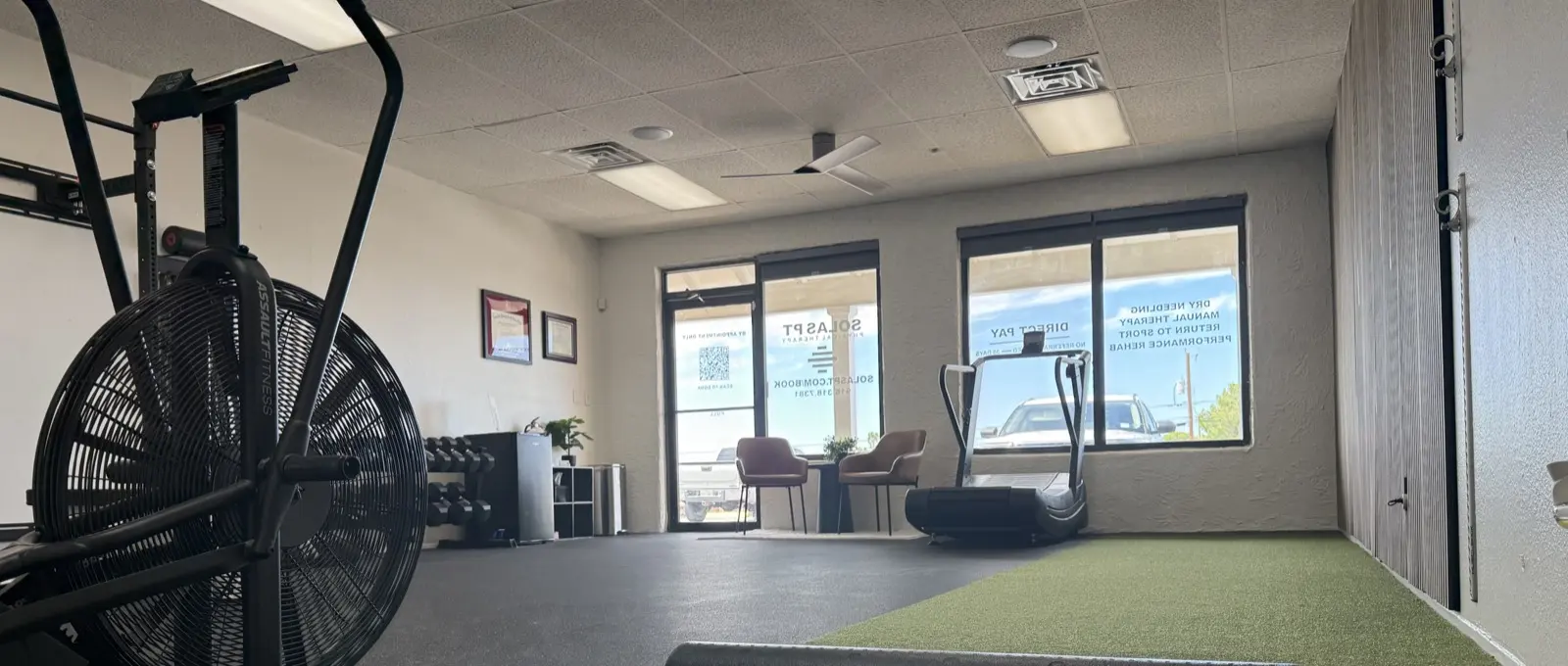
The Solas Physical Therapy clinic floor in El Paso: turf lane, curved treadmill, assault bike and dumbbells used for hip strengthening
No Referral Required · Evenings & Weekends

Gluteal Tendinopathy &
Hip Flexor Tendinopathy Treatment

Pain on the outside of your hip that wakes you when you roll onto that side, or aches on the stairs? That is usually gluteal tendinopathy, not just "bursitis", and it responds to the right loading, not rest. Dr. Andrew Cisneros, PT, DPT, MS treats it one-on-one, a full hour every visit, in west El Paso, and trains the same glute strength with every hip, knee, back and foot patient.

Typical approach
✗ "It's bursitis, rest it"
✗ IT band stretches
✗ Side-lying leg lifts with a band
✗ Another cortisone shot
Solas PT
✓ Hip joint and back ruled out first
✓ Compressed positions changed
✓ Progressive loading with real weights
✓ Dry needling when it helps
✓ Evenings & weekends, no referral
★★★★★ Verified Patient Reviews
★★★★★

"My daughter has been a patient of Dr. Cisneros for two separate injuries, and we've had an amazing experience both times. He is professional, encouraging, knowledgeable, and kind. He creates a fun and positive environment that makes recovery enjoyable and motivating. I highly recommend him — especially athletes working to get back into sports."

— Elzunia Edwards
★★★★★

"Andrew did a thorough assessment of my injury and explained my issues in a way I could understand. He recommended dry needling, talked me through the treatment, and I felt the work immediately. Within a couple of days I was back to full function with my training. Highly recommend if you are looking for one-on-one time with a physical therapist!"

— Josh Silvas
★★★★★

"Dr. Cisneros is one of a kind. Not only is he excellent in making you feel better but also getting you moving like you're supposed to again. He is so kind and compassionate and just an overall good person. Do yourself a favor and book an appointment — you won't regret it one bit!"

— Brit
See All Reviews on Google →

What Is Gluteal Tendinopathy?

Gluteal tendinopathy is irritation of the gluteus medius and gluteus minimus tendons where they attach to the bony point on the outside of the hip. It is the most common cause of what is often called hip bursitis, now also called greater trochanteric pain syndrome. The tendon is not inflamed so much as overloaded and squeezed, which is why it improves with the right strength work and gets worse with stretching across the body.

Who gets it: most often women in their 40s to 60s, including through perimenopause and menopause, plus runners and hikers, people who stand hanging on one hip, side sleepers, and anyone after a jump in walking, stairs or hill work.

It is treated at every stage, from a new ache to pain that has lasted years and several injections.

60

Minutes, one-on-one with the same Doctor of Physical Therapy at every visit.

7

Days a week of appointments, including evenings and weekends.

0

Referrals needed for the first 30 days. Book directly.

Does This Sound Like Your Hip?

Pain mainly in the groin, pain that runs below the knee with numbness or tingling, or pain after a fall that makes it hard to bear weight points somewhere else: the hip joint, the low back or a fracture. Those are screened for at the first visit, and hip pain with fever or unexplained weight loss should be checked by a physician.

One Muscle, The Whole Leg

The Glute Med Is Part of Every Leg Plan

The gluteus medius holds your pelvis level every time you stand on one leg, which is every step you walk, every stair and every stride you run. When it cannot keep up, the pelvis drops, the thigh drifts inward and the knee and foot collapse with it, and the extra load lands somewhere else. That is why glute med strength and control are tested and trained with every hip, knee, low back, foot and ankle patient at Solas PT, not just the ones with hip pain.

🦴

Hip

Hip pain of every kind, and labral tears: a stronger glute med takes load off the front of the hip joint and steadies the pelvis on every step.

🧍

Low Back

Low back pain and sciatica: when the pelvis drops or tilts with each step, the low back makes up the difference, mile after mile.

🦵

Knee

Knee pain, kneecap pain and IT band pain: a thigh that drifts inward takes the kneecap with it. Also part of every ACL and knee replacement plan.

🦶

Foot and Ankle

Plantar fasciitis, Achilles tendinopathy and repeat ankle sprains: when the knee collapses inward, the arch and Achilles absorb the rest.

🏃

Running

Hip drop shows up on film in a running gait analysis, and it is behind a large share of runner's knee, IT band and shin pain.

🏋️

Lifting and Sport

Knees caving on squats and landings, hips shifting on deadlifts: lifters and athletes train single-leg control under real load.

Hip Flexor Tendinopathy

Pain at the front of the hip when lifting the knee, getting out of a car, sprinting, kicking or doing sit-ups is often the iliopsoas or rectus femoris tendon. It is common in runners, soccer players, dancers and lifters, and it often travels with a weak glute med, because a hip that cannot stabilize from the side leans on the front.

Rule Out the Joint First

Front-of-hip and groin pain can also come from the hip joint, such as a labral tear or impingement, or in runners from a bone stress injury. The evaluation separates them before the plan is built.

Load It, Do Not Just Stretch It

A sore hip flexor tendon is usually overloaded, not tight. Treatment loads it progressively, from holds to full-range strength and then speed, alongside the glute and trunk work that takes the strain off it.

Keep Training Around It

Most people keep running or lifting with adjustments while it settles, with sprinting, kicking and deep hip flexion added back on a schedule.

The Process

How Gluteal Tendinopathy Is Treated

Education plus progressive exercise is the treatment with the strongest evidence for gluteal tendinopathy. In a large randomized trial (Mellor and colleagues, BMJ 2018) it did better than a cortisone injection at eight weeks and better than waiting it out at one year.

01

Evaluation, Not Assumption

A full hour, one-on-one. Outer hip pain can also come from the hip joint or the low back, so those are checked first. The tendon is confirmed with specific tests, and single-leg strength and control are measured.

02

Take the Squeeze Off the Tendon

The positions that compress the tendon are found and changed: crossing the legs, hanging on one hip while standing, side-lying with the top knee dropped, and stretches across the body. This alone often settles night pain within days.

03

Isometrics to Calm the Pain

Holds that load the gluteal tendons without moving the joint, used to bring pain down early and repeated at home.

04

Progressive Loading

Bridges, step-ups, split squats, single-leg deadlifts, sled pushes and lateral work, with weight added week by week. Dumbbells and the barbell, not just bands. Manual therapy and dry needling are added when they help.

05

Back to Stairs, Hikes and Runs

Walking, stairs, hiking, running and lifting return on criteria: single-leg control that holds and pain that stays settled the next morning. Glute med strength stays in your program after discharge.

More Than a Band Around the Knees

Tendons recover with load, and a resistance band runs out of load fast. The clinic has the dumbbells, sled, boxes and rack to keep progressing the hip for as long as it needs.

Common Questions

Gluteal Tendinopathy FAQ

Gluteal tendinopathy is irritation of the gluteus medius and gluteus minimus tendons where they attach to the bony point on the outside of the hip (the greater trochanter). It causes aching on the outer hip that is tender to press, hurts when lying on that side, and flares with stairs, hills, standing on one leg or sitting with the legs crossed. It is the most common cause of what used to be called hip bursitis, and it is now often called greater trochanteric pain syndrome.

At Solas Physical Therapy in west El Paso, Dr. Andrew Cisneros, PT, DPT, MS treats gluteal tendinopathy and hip flexor tendinopathy one-on-one, for a full hour every visit, at 300 N Resler Dr, Ste F. No referral is needed to start, evening and weekend appointments are available, and the evaluation is $150 with follow-up visits at $120, paid per visit.

Mostly, yes. Pain on the outside of the hip was long blamed on an inflamed bursa, but imaging shows the gluteal tendons are usually the main source, with the bursa irritated alongside them. The difference matters because tendons need the right load to recover, while rest and stretching across the body tend to keep them sore.

Lying on the painful side presses the tendon against the bone. Lying on the other side lets the top knee drop across the body, which stretches and squeezes the same tendon. A pillow between the knees, or a soft topper, keeps the top leg level and usually helps within days, while treatment works on the cause.

Usually not early on. Stretches that pull the leg across the body, like the classic IT band stretch or a figure-four, compress the irritated gluteal tendons and often make the pain worse. Treatment starts with avoiding those compressed positions and loading the tendon with strength work instead.

It can calm the pain for a few weeks, but the pain often returns. In a large randomized trial (Mellor and colleagues, BMJ 2018), education plus a progressive exercise program did better than a cortisone injection at eight weeks, and better than waiting it out at one year. Many people try physical therapy first and keep the injection as an option with their physician.

They can contribute. The gluteus medius holds the pelvis level each time you stand on one leg. When it cannot, the pelvis drops, the thigh drifts inward and the knee and foot collapse with it, which adds load to the kneecap, the low back, the plantar fascia and the Achilles. Not every leg problem is a glute problem, but at Solas PT glute med strength and control are tested and trained with every hip, knee, back, foot and ankle patient.

Most people notice easier nights within the first two weeks once compressed positions are managed, and a clear improvement in walking, stairs and sleep over six to twelve weeks of progressive loading. Tendons adapt slowly, so the strength program keeps building after the pain settles to keep it from coming back.

Hip flexor tendinopathy is irritation of the iliopsoas or rectus femoris tendon at the front of the hip. It hurts when lifting the knee, getting in and out of a car, sprinting, kicking or doing sit-ups, and is common in runners, soccer players and lifters. Because pain at the front of the hip can also come from the hip joint itself, such as a labral tear, the evaluation sorts out which one it is first.

Sports Patient · Local Guide

★★★★★

"Andrew was very professional, attentive, and knowledgeable. He listened to the pain I was having in my shoulder and gave me the right treatment to get me back to my rock climbing activities."

Moe' — Rock Climber · El Paso
★ Verified Google Review · Solas PT · Local Guide
  Sleep On Either Side Again

Get the Hip Strong, Not Just Rested.

Book an evaluation at the Solas PT clinic on Resler Dr: a full hour, one-on-one, with changes you can make tonight and a loading plan before you leave.

Book Your Evaluation → All Hip Pain
Call (915) 318-7381 · Text Us

Also read: Hip Labral Tear → · Dry Needling → · Running Gait Analysis →