Stiff neck, upper traps like concrete by mid-afternoon, or an ache between the shoulder blades from desk work, lifting or posture? That is usually muscle and joint, not damage, and it responds to releasing the tight tissue, restoring the motion underneath and then strengthening what holds your head up. Dr. Andrew Cisneros, PT, DPT, MS treats it one-on-one, a full hour every visit, in west El Paso.
"Andrew did a thorough assessment of my injury and explained my issues in a way I could understand. He recommended dry needling, talked me through the treatment, and I felt the work immediately. Within a couple of days I was back to full function with my training. Highly recommend if you are looking for one-on-one time with a physical therapist!"
"Dr. Cisneros is one of a kind. Not only is he excellent in making you feel better but also getting you moving like you're supposed to again. He is so kind and compassionate and just an overall good person. Do yourself a favor and book an appointment — you won't regret it one bit!"
"My daughter has been a patient of Dr. Cisneros for two separate injuries, and we've had an amazing experience both times. He is professional, encouraging, knowledgeable, and kind. He creates a fun and positive environment that makes recovery enjoyable and motivating. I highly recommend him — especially athletes working to get back into sports."
Most neck and upper back pain is mechanical. The upper trapezius, levator scapulae and the small suboccipital muscles at the base of the skull stay tight and tender, the joints of the neck and upper back stop moving well, and the muscles that hold the head and shoulder blades up tire out before the workday does. Hours at a screen, driving, phone use and heavy pressing all feed it. It is rarely damage, which is why it responds to releasing the muscle, restoring the joint motion underneath and then strengthening what holds the head up, and why rest alone keeps it coming back.
Who gets it: desk and remote workers, drivers, nurses and dental staff who look down all day, lifters who press overhead or hold a front rack, and anyone whose neck now locks up by 3 pm.
It is treated at every stage, from a stiff neck this week to pain that has lasted years, with or without prior physical therapy.
Minutes, one-on-one with the same Doctor of Physical Therapy at every visit.
Days a week of appointments, including evenings and weekends.
Referrals needed for the first 30 days. Book directly.
Pain, numbness, tingling or weakness running down the arm points to a nerve, not a muscle, and is assessed before any neck treatment. See a physician or the emergency room first for neck pain after a significant fall or collision, a sudden severe headache unlike any before, neck pain with fever, dizziness, double vision or trouble speaking or swallowing, or progressive weakness or clumsiness in the hands or legs. Those are screened for at the first visit.
A stiff neck is usually three problems stacked together, and treating only one of them is why the relief from a massage or a stretch lasts a day. Each one is addressed at Solas PT.
The upper trapezius, levator scapulae and suboccipitals hold the head all day and develop tight, tender bands that refer pain up the neck and into the head. Stretching them rarely holds. Dry needling with electrical stimulation releases them directly.
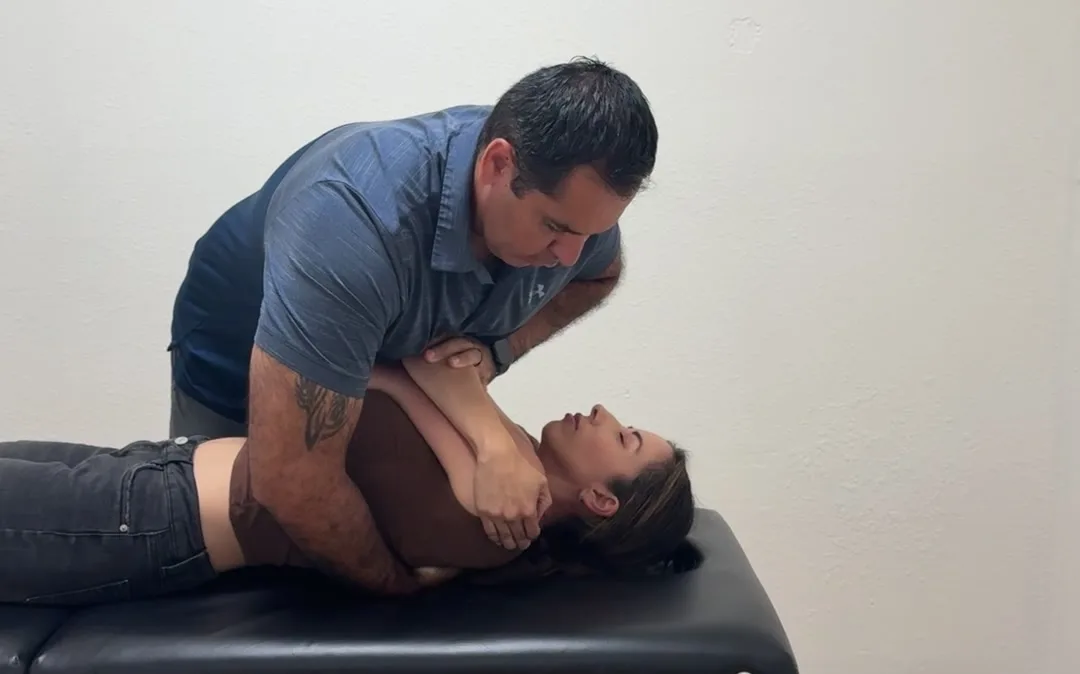
Hours of sitting round the mid and upper back and it stops moving. The neck then does the turning and extending the upper back should share, and it wears out. Thoracic thrust manipulation restores that motion, and research supports it for short-term neck pain relief.
The deep neck flexors and the muscles that hold the shoulder blades down and back fatigue long before the workday ends, and the traps take over. Loading them, from chin tucks and pull-aparts to rows, carries and overhead work, is what makes the relief last.
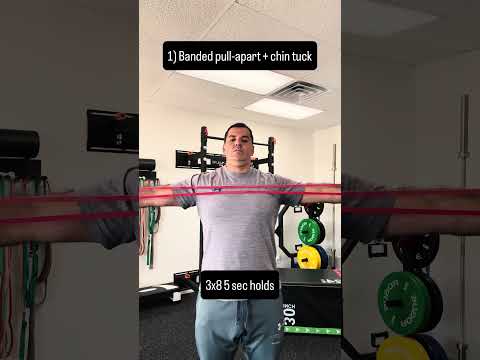
Three moves Dr. Cisneros gives desk workers between visits. They load the muscles that hold the head up and open the upper back, which is the opposite of what a day at the screen does.
Daily, or as a midday break. They take a few minutes. The idea is to stretch what is overworked and strengthen what is underworked.
Stop if pain shoots down your arm. That is evaluation territory, not internet territory. Stiffness that comes with numbness, tingling, arm weakness or headaches that keep getting worse gets evaluated, and if the neck still will not loosen up, that is what the evaluation is for.
Release the muscle, restore the motion underneath, then strengthen what holds the head up. In that order, in the same visit, by the same Doctor of Physical Therapy every time.
A full hour, one-on-one. The nerves are screened first, because arm symptoms change the plan. Then the neck, the upper back and the ribs are examined for the joints that are not moving, the trigger points that reproduce your pain are found, and the endurance of the muscles that hold the head and shoulder blades is tested.
Thin filament needles into the upper trapezius, levator scapulae and suboccipital trigger points, with e-stim through the needle to release the muscle tension. Needling around the neck is done with the head supported and the needle angled away from the ribcage and lungs. More on dry needling for the neck →
A quick, controlled thrust to the mid and upper back restores the motion the neck has been covering for, and graded mobilization of the cervical joints follows. Done only after a screen for contraindications, by a licensed DPT. Watch the needling and the manipulation together →
Chin tucks and banded pull-aparts first, then rows, prone presses, carries and landmine work with real weight, and overhead pressing added back on a schedule. The upper back and scapular muscles take the job back from the traps.
Screen height, the afternoon routine, how you hold a front rack: the few changes that stop it from coming back, written into your program before discharge, so you are not back in three months with the same neck.
Needling and manipulation happen in a private treatment room. The strength work that makes it last happens on a training floor with the weight to keep progressing the upper back.
Most persistent neck pain is mechanical: the upper trapezius, levator scapulae and suboccipital muscles stay tight and tender, the joints of the neck and upper back stop moving well, and the muscles that hold the head and shoulder blades up tire out by the afternoon. Hours at a desk, driving, phone use and heavy pressing all feed it. It is rarely damage, which is why it responds to releasing the muscles, restoring the joint motion and then strengthening what holds the head up, rather than to rest.
At Solas Physical Therapy in west El Paso, Dr. Andrew Cisneros, PT, DPT, MS treats neck and upper back pain one-on-one, for a full hour every visit, at 300 N Resler Dr, Ste F. No referral is needed to start, evening and weekend appointments are available, and the evaluation is $150 with follow-up visits at $120, paid per visit.
When the head drifts forward over a screen, the upper traps and the small muscles at the base of the skull work all day to hold it there, the upper back rounds and stiffens, and by mid-afternoon the neck feels like concrete. Usually it is posture fatigue, not damage: the upper traps stay switched on while the deep neck flexors and mid-back muscles that hold you upright switch off. Three moves help between visits: a banded pull-apart with a chin tuck, a seated upper trap stretch, and a prone banded press with a chin tuck, done daily or as a midday break. Stop if pain shoots down your arm, and if the neck still will not loosen up, that is what the evaluation is for. The desk routine →
Yes. Most stiff, aching necks and the tension headaches that come with them start in trigger points in the upper trap, levator scapulae and the small suboccipital muscles at the base of the skull. Dry needling those muscles, often with electrical stimulation through the needle, eases the pain quickly. At Solas PT it is paired in the same visit with thoracic thrust manipulation and then with strength work so the tightness does not return. Dry needling for the neck →
A thoracic thrust manipulation is a quick, controlled movement applied to the mid and upper back by a licensed physical therapist, usually with you lying on your back over the therapist's hands. You may hear a pop. It restores motion in the upper back, which takes load off the neck, and research supports it for short-term relief of neck pain. It is done only after a screen for contraindications, and most people describe it as a release rather than pain. Watch it →
Yes. A headache that starts at the base of the skull, often on one side, and that pressing on the neck can reproduce is a cervicogenic headache, meaning it is generated in the neck rather than the head. Solas PT treats it with sustained sub-occipital release, upper-cervical mobilization, thoracic manipulation and dry needling, and relief often begins in the first session. Cervicogenic headache treatment →
Pain, numbness, tingling or weakness running down the arm points to a nerve rather than a muscle and needs a full assessment before any neck treatment. See a physician or the emergency room first for neck pain after a significant fall or collision, a sudden severe headache unlike any before, neck pain with fever, dizziness, double vision or trouble speaking or swallowing, or progressive weakness or clumsiness in the hands or legs. Those are screened for at the first visit.
Many people feel looser the same day after dry needling and manipulation, and a recent flare often settles in one to three visits. A neck that has been tight for months is usually treated weekly for several weeks while the strength program builds, because the muscles that hold the head up need time to catch up with a full workday.
Pain between the shoulder blades after sitting or driving usually comes from a mid and upper back that has stopped moving and from the rhomboid and lower trapezius muscles working overtime to hold the shoulder blades back. Short term, standing up, pulling a band apart at chest height and pressing it overhead and behind the head opens the upper back and takes the ache down. For relief that lasts, the stiff thoracic segments are manipulated and the muscles between the shoulder blades are strengthened with rows, prone presses and carries. Pain between the shoulder blades with chest pain, shortness of breath or sweating is not a muscle problem and needs emergency care. The desk routine →
Tech neck is the neck and upper back pain that comes from hours with the head bent forward over a phone or laptop. Every inch the head drifts forward adds load the upper traps and the small muscles at the base of the skull have to hold, and the upper back rounds to match. Fixing it is not about sitting up straight all day, which no one can do. It is raising the screen to eye level, breaking up the sitting, and building the endurance of the deep neck flexors and the muscles that hold the shoulder blades back, starting with chin tucks and banded pull-aparts, so the neck can tolerate a workday. Dry needling and thoracic manipulation settle the pain while that strength is built.
The best physical therapist for neck pain is one who screens the nerves and red flags before treating, releases the upper trap and neck trigger points, restores upper back motion with manipulation, and then strengthens the muscles that hold your head up so it does not come back. Solas Physical Therapy in west El Paso holds a 5.0-star rating across 47 Google reviews. Every session is one-on-one with Dr. Andrew Cisneros, PT, DPT, MS for the full 60 minutes, with dry needling and manipulation done in the same visit. Solas PT is cash-based and direct-access at 300 N Resler Dr, Ste F, and can usually see new patients the same week with no referral required.
Usually, with adjustments. Heavy overhead pressing, front rack holds and shrugging through a lift are the common aggravators, so those are modified while the neck settles and the upper back and scapular muscles are loaded first. Overhead work is added back on a schedule, and the gym at Solas PT has the rack, dumbbells and landmine to rebuild it under real load. Physical therapy for lifters →
Sports Patient · Local Guide
"Andrew was very professional, attentive, and knowledgeable. He listened to the pain I was having in my shoulder and gave me the right treatment to get me back to my rock climbing activities."
Book an evaluation at the Solas PT clinic on Resler Dr: a full hour, one-on-one, with the needling and manipulation done the same visit and a strength plan before you leave.
Also read: Dry Needling → · Manual Therapy → · Shoulder Pain →