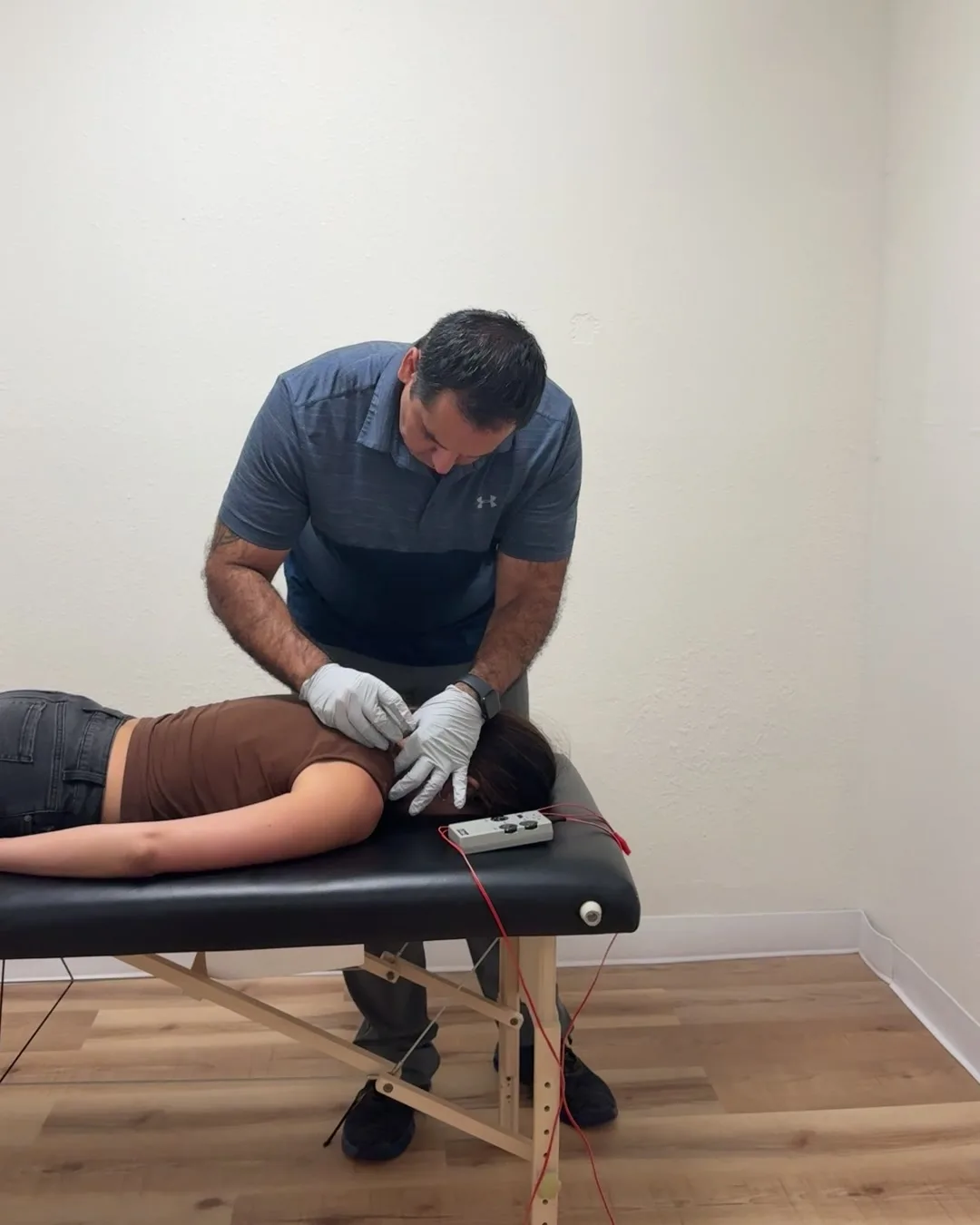
Dry needling uses a thin needle to release the tight knot in a muscle that keeps hurting. Most people feel a brief cramp or twitch, then soreness for a day, then relief. At Solas PT it is a $100 focused visit or part of a full evaluation, with no referral needed, and you can usually be seen this week. This is the dry needling El Paso lifters, runners and desk workers come to when stretching and massage have stopped working.
"I've been a patient with Andrew for over a year, primarily for dry needling therapy, and I can't recommend him highly enough. He has helped me significantly relieve chronic muscle pain, and every session brings noticeable relief. His approach is both effective and personalized — Solas Physical Therapy is absolutely worth it."
"Dr. Cisneros performed dry needling on my shoulder and trapezius area over 3 sessions. He was very professional, patient, and knowledgeable. He knew exactly what points to treat and which points to avoid. I recommend him without any reservations."
"Andrew did a thorough assessment of my injury and explained my issues in a way I could understand. He recommended dry needling, talked me through the treatment, and I felt the work immediately. Within a couple of days I was back to full function with my training. Highly recommend if you are looking for one-on-one time with a physical therapist!"
Dry needling uses thin monofilament needles to target myofascial trigger points — the tight, knotted bands inside muscles that cause local pain and referred pain patterns. When a needle is inserted into a trigger point, it causes a brief twitch response that resets the muscle, reduces tension, and restores normal blood flow to the area. It is rooted in Western medicine and neuroscience — not traditional Chinese medicine. Despite using the same needles, dry needling is completely different from acupuncture.
At Solas PT, dry needling is always combined with manual therapy, movement correction and exercise. A needle alone does not fix why the trigger point formed.
Sessions often needed to feel significant relief for acute muscle pain — though chronic conditions may require more
Dr. Cisneros holds a formal dry needling certification and integrates it into comprehensive physical therapy plans
Referrals required. Walk in with muscle pain, leave with a plan. Direct access PT in Texas means you can start immediately.
Two pages go deeper on the most common reasons patients come in for dry needling in El Paso:
Dry needling is highly effective for musculoskeletal pain caused by trigger points and myofascial dysfunction. Here are the most common conditions Dr. Cisneros treats with it.
Chronic tightness, stiffness, and referred headaches often stem from trigger points in the traps, levator scapulae, and suboccipitals. Dry needling provides faster relief than stretching alone.
Trigger points in the rotator cuff muscles, deltoid, and pecs contribute to shoulder impingement, weakness, and restricted range of motion. Dry needling helps reset these tissues before strengthening.
Runners, cyclists, and CrossFitters often develop persistent lateral hip and knee pain from TFL and glute trigger points. Dry needling releases these faster than foam rolling ever will.
Paraspinal, glute, and piriformis trigger points are a major driver of chronic low back pain and sciatica-like symptoms. Dry needling these areas can dramatically reduce pain within sessions.
Athletes with persistent leg tightness that doesn't respond to stretching often have active trigger points. Dry needling resolves the underlying tissue restriction so strength training can be effective again.
Many chronic tension headaches originate from trigger points in the neck and upper traps, not the head itself. Dry needling these cervical muscles is one of the most effective treatments available.
The three areas people ask about most. Each answer covers what Dr. Cisneros needles, what it feels like, how many sessions it usually takes, and what it costs.
Yes, when the pain comes from trigger points in the rotator cuff, upper trap, deltoid or pec muscles: the tight, achy shoulder that hurts overhead and will not loosen with stretching. Dry needling lowers that pain and restores range within a few sessions so strengthening can do its job. It does not repair a torn rotator cuff, and a shoulder with true weakness is assessed for that first.
Infraspinatus, supraspinatus and teres minor behind the shoulder blade, the upper trap, pec minor and the deltoid. Over the upper back and ribcage Dr. Cisneros adjusts needle depth and angle, which is why the intake asks about lung history and build.
A brief twitch when the needle finds the trigger point, then pressure on the site for a few seconds. Mild soreness for a day or two is normal.
Acute shoulder tightness often settles in 1 to 3 sessions. A shoulder that has been stiff for months usually needs weekly sessions for several weeks, each paired with loading work.
At Solas PT a standalone dry needling visit is $75, or dry needling is included in a $120 one-hour session. A first visit is the $150 evaluation, or the $100 focused dry needling consultation when it is one area. Paid per visit, nothing up front, HSA and FSA accepted.
Yes. Most stiff, aching necks and the tension headaches that come with them start in trigger points in the upper trap, levator scapulae and the small suboccipital muscles at the base of the skull, not in the neck joints. Dry needling those muscles eases the pain and headache quickly. For neck and upper back pain from desk work, lifting or posture, Dr. Cisneros pairs it in the same visit with thoracic thrust manipulation, a quick, controlled movement to the mid and upper back that restores spinal mobility and is supported by research for short-term neck pain relief, then with posture and strength work so the tightness does not return. The full neck and upper back pain page →
Stiff neck, tight upper traps, or pain between the shoulder blades from desk work, lifting or posture. Two hands-on treatments, in order:
Then the exercise that keeps it from coming back. No referral needed — book an evaluation.

Upper trap, levator scapulae, suboccipitals, and the muscles along the shoulder blade that pull on the neck from below. Needling around the neck is done with the head supported and the needle angled away from the ribcage and lungs.
A twitch, then a warm, heavy feeling in the muscle. Many people feel the headache ease during the session. Soreness for a day or two is common.
Numbness, tingling or weakness down the arm points to the nerve, not the muscle. That gets a full assessment first, and the plan changes.
Typically 1 to 3 for a recent flare, weekly for several weeks when the neck has been tight for months.
At Solas PT a standalone dry needling visit is $75, or dry needling is included in a $120 one-hour session. A first visit is the $150 evaluation, or the $100 focused dry needling consultation when it is one area. Paid per visit, nothing up front, HSA and FSA accepted.
Yes, for the deep, hard-to-reach hip pain that foam rolling never touches: trigger points in the gluteus medius and minimus, TFL, piriformis and the deep rotators. That is the pain on the outside of the hip, the IT band tightness runners get, and the sciatica-like ache down the back of the leg. Dry needling reaches those muscles directly and is followed by hip strengthening so the pattern changes.
Gluteus medius and minimus on the side of the hip, TFL at the front, piriformis and the deep rotators behind. Lower back and hip are often treated together because the same trigger points feed both.
The glutes give a strong twitch, which people describe as a deep ache that then releases. Soreness for a day or two is normal.
Runners and lifters with a recent flare often improve in 1 to 3 sessions. Longstanding hip and IT band pain is treated weekly for several weeks alongside single-leg strength work.
If your main symptom runs down the leg, see dry needling for sciatica in El Paso.
At Solas PT a standalone dry needling visit is $75, or dry needling is included in a $120 one-hour session. A first visit is the $150 evaluation, or the $100 focused dry needling consultation when it is one area. Paid per visit, nothing up front, HSA and FSA accepted.
Every session starts with an assessment — not a needle. Dr. Cisneros identifies the trigger points contributing to your symptoms before any treatment begins.
Before picking up a needle, Dr. Cisneros assesses your movement patterns and palpates for active trigger points. This ensures needles go exactly where they're needed — not just where it hurts.
Thin monofilament needles are inserted into the identified trigger points. You'll likely feel a brief muscle twitch — that's the target response. Most patients describe it as a deep cramping sensation that quickly resolves. The needle is in and out in seconds.
After dry needling, the tissue is more receptive to manual therapy. Dr. Cisneros follows with hands-on soft tissue work and joint mobilization to maximize the effect and restore full movement.
Dry needling removes the roadblock — exercise rebuilds the foundation. You'll leave every session with targeted exercises that address why the trigger points developed and prevent them from coming back.
Needling happens in a private treatment room. Then the muscle that was needled gets loaded on the floor in the same visit — which is what makes the change last — with real strength and performance equipment, not just bands.
Patient Result
"I suffer from Cervical Dystonia, and the dry needling I received from Andrew Cisneros helped to alleviate the pain and muscle tightness from this disorder."
"Every session brings noticeable relief. Andrew truly takes the time to understand what your body needs. His approach is both effective and personalized — Solas PT is absolutely worth it."
"Andrew took great care with the examination of the problem. Super clean facility and top notch treatment. Extremely knowledgeable of the situation and treatments to improve recovery. Andrew knows his stuff and how to proceed with care. The dry needling worked wonders. Highly recommend the procedure and this facility."
"I went to see Andrew for dry needling and he was awesome. He did a great job of explaining what he was doing and followed up with exercises to help with my neck and shoulder pain. I would highly recommend Solas."
There can be some discomfort, but most patients tolerate it very well — especially once Dr. Cisneros explains the mechanics of the procedure beforehand, which puts people at ease. A brief muscle twitch when the needle reaches the trigger point is normal and is actually the goal. With the coning method, he presses the site for 3–5 seconds right after the needle comes out. That eases any discomfort, especially after a strong twitch response. Mild soreness for 24–48 hours afterward is normal.
They use the same thin needles, but they are different treatments done by different providers for different reasons. Dry needling is a physical therapy technique: Dr. Cisneros finds the tight, tender trigger points in a muscle by watching how you move and pressing on the tissue, then needles those exact spots to trigger a twitch that releases the muscle. It is one part of a session that also includes hands-on work and strengthening, so the release holds. Acupuncture is a practice from Traditional Chinese Medicine, performed by a licensed acupuncturist, that places needles at set points along meridians to influence the flow of energy, and it is used for a much wider range of complaints. If your problem is a stubborn, tight muscle that limits how you move, dry needling is the direct route. In Texas, physical therapists perform dry needling under the state physical therapy board's rules.
Acute muscle pain often responds in 1–3 sessions. Chronic conditions with longstanding trigger points may take longer. Dr. Cisneros will give you an honest estimate after your first session — there's no pressure to commit to a package upfront. Most patients notice meaningful improvement within the first two visits.
Most insurance plans do not cover dry needling, and many don't cover physical therapy the way patients expect. At Solas PT, we're cash-based — which means transparent pricing, no surprise bills, and no fighting with insurance. You know exactly what you're paying before your first session. Check our pricing page for details.
No. Texas is a direct access state, which means you can see a physical therapist — and receive dry needling — without a physician's referral. You can call or book online today and start treatment as early as this week.
Yes, when performed by a trained and certified clinician. Dr. Cisneros uses sterile, single-use needles and follows strict safety protocols. He has formal dry needling certification with extensive hands-on training. Minor bruising or soreness at the needle site is the most common side effect — serious complications are extremely rare.
Most patients describe a local twitch response when the needle reaches the trigger point — a brief, involuntary muscle cramp or deep ache that lasts only a second or two. Between trigger points, the needle is barely perceptible. Many patients are surprised by how tolerable it is. After the session, you may feel mild soreness similar to post-workout muscle fatigue — that's normal and typically resolves within 24–48 hours. By day two, most patients feel noticeably looser and less painful than before treatment.
After a session, patients often feel relief lasting several days, a week, or sometimes several weeks. To build longer-lasting effects — particularly for chronic conditions — Dr. Cisneros recommends dry needling on a weekly basis, so each session compounds on the last rather than the benefit fading between visits. Many patients also notice less tightness and improved range of motion immediately after the first session. He'll give you a realistic timeline after your initial assessment — no vague "package" commitments.
Dry needling works through several mechanisms. When a needle enters a trigger point, it disrupts the abnormal electrical activity in the muscle fiber, releasing the sustained contraction. The local twitch response flushes out inflammatory substances like substance P and bradykinin that accumulate in trigger points. It also stimulates Aδ and C nerve fibers, activating the body's endogenous pain-modulating pathways — essentially telling your nervous system to reduce pain signals in that region. Research has shown dry needling produces lasting analgesic effects for conditions like shoulder impingement and chronic neck pain, with effects comparable to or exceeding cortisone injections without the tissue damage.
They work differently and serve different purposes. Cupping uses suction to lift superficial tissue and increase blood flow to the skin and fascia — it's effective for surface tension and circulation. Dry needling targets deep myofascial trigger points that cupping cannot reach. For true trigger point pain, restricted muscle tissue, or nerve sensitization, dry needling has significantly stronger evidence behind it. Some clinicians use both together. At Solas PT, Dr. Cisneros selects the tool that fits your specific diagnosis — not every trend in sports recovery.
In physical therapy, dry needling is a clinical intervention used to treat myofascial pain, muscle dysfunction, and movement restrictions. It's one tool within a broader treatment plan — not a standalone therapy. Licensed physical therapists who hold a dry needling certification (like Dr. Cisneros) use it alongside manual therapy, therapeutic exercise, and movement retraining. Unlike an injection or an acupuncture session, dry needling at a PT clinic is tied to a rehab goal. Reduce pain, restore movement, then rebuild strength so the problem does not return.
Yes — and that's exactly how Dr. Cisneros practices. Dry needling and manual physical therapy work synergistically. The needle resets the trigger point and calms pain sensitivity. The hands-on work that follows then restores joint mobility more easily, because the muscle is no longer guarding. At most insurance-based PT clinics, this combination is difficult to deliver in one visit due to time and billing constraints. At Solas PT, your session is dedicated entirely to your needs — there's no clock being watched for billing codes.
At Solas PT, dry needling is included as part of a one-on-one physical therapy session — you don't pay separately for each modality. A standard session with Dr. Cisneros includes assessment, dry needling, manual therapy, and exercise prescription. Visit our pricing page for current rates. Because we're cash-based, you know the exact cost before you book — no surprise bills, no insurance denials, no co-pays stacking up for months.
We'll let our patients answer that — check our Google reviews. What sets Solas PT apart is that Dr. Cisneros is a Doctor of Physical Therapy (DPT) with formal dry needling certification who personally treats every patient. There are no aides performing your treatment, no rotating staff, no rushed 15-minute sessions. He also pairs dry needling with hands-on manual therapy and a progressive exercise plan. Large chain clinics in El Paso cannot match that within an insurance billing structure.
A Doctor of Physical Therapy (DPT) holds a clinical doctorate — the current entry-level degree for the profession. Older PTs may hold a Master's degree (MPT or MSPT). For dry needling specifically, the credential to look for is separate: a certified dry needling course with adequate hands-on hours. Dr. Cisneros holds both a DPT from an accredited program and formal dry needling certification. When you're getting needles inserted into specific muscle tissue, you want someone with the deepest anatomical training available — not just someone who attended a weekend seminar.
Yes, when the pain comes from trigger points in the rotator cuff, upper trap, deltoid or pec muscles: the tight, achy shoulder that hurts overhead and will not loosen with stretching. Dry needling lowers that pain and restores range within a few sessions so strengthening can do its job. It does not repair a torn rotator cuff, and a shoulder with true weakness is assessed for that first. More on dry needling for the shoulder →
Yes. Most stiff, aching necks and the tension headaches that come with them start in trigger points in the upper trap, levator scapulae and the small suboccipital muscles at the base of the skull, not in the neck joints. Dry needling those muscles, often with electrical stimulation through the needle, eases the pain and headache quickly. For neck and upper back pain from desk work, lifting or posture, Dr. Cisneros pairs it in the same visit with thoracic thrust manipulation, a quick, controlled movement to the mid and upper back that restores spinal mobility and is supported by research for short-term neck pain relief, then with posture and strength work so the tightness does not return. Watch the 18-second demo →
Yes, for the deep, hard-to-reach hip pain that foam rolling never touches: trigger points in the gluteus medius and minimus, TFL, piriformis and the deep rotators. That is the pain on the outside of the hip, the IT band tightness runners get, and the sciatica-like ache down the back of the leg. Dry needling reaches those muscles directly and is followed by hip strengthening so the pattern changes. More on dry needling for the hip →
Acute muscle pain often responds in 1–3 sessions. Chronic conditions with longstanding trigger points may take longer. Dr. Cisneros will give you an honest estimate after your first session — there's no pressure to commit to a package upfront. Most patients notice meaningful improvement within the first two visits.
Look for a Licensed Physical Therapist (DPT) who holds a specific dry needling certification — not just a weekend course. In Texas, dry needling must be performed by a licensed PT. Dr. Andrew Cisneros, PT, DPT, MS, at Solas PT in El Paso holds formal dry needling certification. Sessions are one-on-one at 300 N Resler Dr, Ste F, El Paso, TX 79912. No referral required.
Prioritize a licensed physical therapist with specific dry needling certification and one-on-one care — avoid high-volume clinics where you see a different provider each visit. Ask whether the therapist performs the treatment themselves or delegates to an aide. At Solas PT, Dr. Cisneros personally evaluates and treats every patient, combining dry needling with a full rehabilitation plan tailored to your specific condition.
Yes — at Solas PT, Dr. Cisneros combines dry needling and manual physical therapy in the same session. The needle resets the trigger point; the hands-on manual therapy that follows restores joint mobility and tissue quality more effectively because the muscle is no longer guarding. This combination is difficult to deliver at most insurance-based PT clinics due to billing constraints, but at Solas PT your entire session is dedicated to your needs.
Yes. Solas PT is located at 300 N Resler Dr, Ste F in West El Paso — inside the Solas Health & Wellness building. We see patients from West El Paso, Northwest El Paso, the Upper Valley, Northeast El Paso, Central El Paso, and East El Paso. Same-week appointments are available. Call or text (915) 318-7381 or book online at solaspt.com/book.
The best physical therapist for dry needling is one who performs it themselves, screens for contraindications first, and uses it as one tool inside a plan with manual therapy and loading. Solas Physical Therapy in west El Paso holds a 5.0-star rating across 47 Google reviews. Dry needling at Solas PT is based on Western anatomy and neuroscience, targeting specific myofascial trigger points identified through clinical assessment rather than a fixed protocol. Dr. Cisneros explains the mechanics of the procedure beforehand, which puts first-time patients at ease. Every session is one-on-one with Dr. Andrew Cisneros, PT, DPT, MS for the full 60 minutes — no aides, no double-booking. Solas PT is cash-based and direct-access at 300 N Resler Dr, Ste F, and can usually see new patients the same week with no referral required.
Electrical dry needling (PENS) passes a low-level current through the needles once they are inside the muscle. TENS applies current through pads on the skin, so it has to pass through skin and fat before it reaches the muscle, and its relief tends to fade once the unit is off. Electrical dry needling reaches the trigger point directly and its relief usually lasts days to weeks. At Solas PT it is included in your session at no extra charge when it is the right tool.
Most patients find it more comfortable than standard dry needling. You feel the needle go in, then a mild rhythmic pulsing for 10 to 15 minutes at a level you choose. Soreness for a day or two afterward is normal.
Anyone with a pacemaker or implanted electrical device, a seizure history, or metal hardware in the muscle being treated. Blood thinners and bleeding disorders are screened before any needling. Pregnancy is a precaution, not a hard stop. Dr. Cisneros screens for all of these before treatment.
Dry needling is safe when performed by a trained and certified clinician. Here's what you should know before your first session.
Mild soreness at the needle site for 24–48 hours is the most common side effect — similar to delayed onset muscle soreness after a hard workout. Minor bruising occasionally occurs. Both are temporary and indicate the treatment is working.
Some patients feel temporarily lightheaded or fatigued after their first session. This is a normal neurological response. Stay hydrated, avoid intense exercise for 24 hours, and apply heat if the treated area is sore.
Drink plenty of water, apply a heating pad to sore areas, and avoid heavy training the same day. Light movement and walking is encouraged. Most patients feel significantly better once the initial 24–48 hour soreness passes.
Dry needling is not appropriate for everyone. Dr. Cisneros will screen you before treatment. It is generally avoided during pregnancy, with a needle phobia, on blood thinners, with a weakened immune system, or when there is an active infection at the site.
Wet needling involves injecting a substance (like cortisone or saline) through the needle. Dry needling uses no injection — the needle itself creates the therapeutic effect by stimulating the trigger point. Dr. Cisneros performs dry needling only, which is within the scope of physical therapy practice in Texas.
Serious complications from dry needling — such as pneumothorax or nerve injury — are extremely rare when performed by a certified clinician. Dr. Cisneros has formal dry needling certification and uses strict safety protocols including sterile, single-use needles for every patient.
Electrical dry needling, also called e-stim dry needling or PENS, passes a low-level current through the needles once they are in the muscle. Standard dry needling works mechanically. Adding current produces rhythmic contractions at the trigger point itself and activates the body's own pain-inhibiting pathways in the spinal cord. For long-standing trigger points, sciatica and headaches, the relief tends to last longer. It is included in your session at no extra charge when it is the right tool.
| Electrical DN | Surface TENS | Standard DN | |
| Where the current goes | Inside the muscle, through the needle | Skin surface, through pads | No current |
| How long relief lasts | Days to weeks | During and shortly after | Hours to days |
| Best for | Chronic and nerve-related pain | Mild, short-term relief | Acute trigger points |
Dr. Cisneros first finds and releases the trigger point with the needle, then attaches the leads. You feel a mild rhythmic pulsing for 10 to 15 minutes, set to a level you find comfortable. Most patients find it more relaxing than standard needling. A visible twitch confirms the current is reaching the right tissue. Soreness for 24 to 48 hours is normal, and relief usually follows once it passes.
Anyone with a pacemaker or other implanted electrical device, a seizure history, or metal hardware in the muscle being treated. Blood thinners and bleeding disorders are screened before any needling. Pregnancy is a precaution rather than a hard stop: it changes where and how the technique is used. All of this is screened before treatment, and standard dry needling often remains an option when the electrical part does not.
For chronic low back pain specifically: electrical dry needling for chronic low back pain →
Dry needling is powerful — but it's a catalyst, not a cure. The reason Solas PT gets results that big clinic chains can't match is that Dr. Cisneros combines manual physical therapy techniques with dry needling in the same session. The needle breaks the cycle. The hands rebuild the tissue. The exercise makes it stick.
Trigger point dry needling resets the abnormal muscle activity, flushes inflammatory compounds, and reduces nerve sensitization. This primes the tissue for hands-on work.
After needling, the tissue is dramatically more receptive. Joint mobilization, soft tissue manipulation, and nerve mobilization restore the full range of motion that pain had been limiting.
Trigger points don't form randomly. They're caused by movement dysfunction, load imbalance, or weakness. Targeted exercise corrects the root cause so the pain doesn't return in six weeks.
Most El Paso physical therapy clinics are forced by insurance to keep sessions under 45 minutes and limit hands-on time to what they can bill. At Solas PT, every session is one-on-one with Dr. Cisneros — a Doctor of Physical Therapy who performs the manual physical therapy and the dry needling himself, not an aide. You get the clinical expertise for the full hour, not the last 10 minutes of it.
Dr. Cisneros works with athletes at a local CrossFit gym — meaning he understands barbell mechanics, high-rep loading, Olympic lifts, and the specific injuries they produce. This isn't general PT dressed up in athletic language. This is sport-specific rehab from a former coach who knows the box.
Unlike most PTs who tell athletes to "rest and ice," Dr. Cisneros builds rehab plans that keep you moving. The goal is load modification, not elimination — so you stay in the gym while the injury heals.
High-mileage runners, triathletes, and endurance athletes face specific overuse patterns — piriformis, IT band, plantar fascia, and calf trigger points that limit training and recovery. Dry needling releases those knots directly so you can keep training through the block, not around it.
Athletes can't afford 3-week wait lists. At Solas PT, most patients are seen within 2–3 days of booking. Evening and weekend availability means you don't have to choose between your session and your training schedule.
Yes — and for many patients in El Paso, dry needling is one of the most effective treatments available for sciatic pain, particularly when the piriformis muscle is involved. See the full guide: dry needling for sciatica in El Paso →
The sciatic nerve runs directly beneath — and sometimes through — the piriformis muscle in the buttock. When that muscle develops trigger points from sitting, overuse, or muscle imbalance, it compresses the sciatic nerve and creates pain, burning, or numbness that travels down the leg. This condition, piriformis syndrome, is frequently misdiagnosed as disc-related sciatica.
Dry needling directly into the piriformis trigger points releases the muscular compression on the nerve — faster and more completely than stretching or massage alone. At Solas PT in El Paso, Dr. Cisneros combines dry needling with nerve flossing and corrective exercise to address both the immediate pain and the underlying cause.
For disc-related sciatica, dry needling the surrounding paraspinal and glute muscles reduces the pain sensitization cycle and makes rehabilitation exercises more effective. Most patients with sciatica in El Paso see meaningful improvement within 2–4 combined sessions of dry needling and physical therapy.
Dry needling releases the piriformis directly — faster than any stretch or massage can reach that depth. Often resolves in 2–3 sessions when caught early.
Dry needling surrounding muscles reduces nerve sensitization and pain, making the core rehab exercises that fix the disc mechanics far more effective.
For stubborn or chronic sciatic pain, Dr. Cisneros uses electrical stimulation through the needles — a advanced technique that amplifies relief and is not widely available in El Paso. Learn about electrical dry needling (PENS) →
Most patients don't know this: most major health insurance plans, including many employer plans and Medicare, classify dry needling as "experimental" or "not medically necessary." So even a clinic with a certified therapist on staff often cannot perform it during your visit. The insurer won't authorize or pay for it.
The bottom line: At Solas PT, if Dr. Cisneros determines that dry needling is the right treatment for your condition — whether it's your first visit or your tenth — we do it. No forms. No denials. No waiting. Your session is shaped entirely by what your body needs, not by what a benefits manager decided to cover this year. This is what cash-based physical therapy was designed to make possible.
Solas PT is located at 300 N Resler Dr, Ste F in West El Paso inside the Solas Health & Wellness building. We see patients from across the city — if you've been searching for dry needling near you in El Paso, this is where to start.
Minutes from our Resler Dr location. Most of our patients are here.
Transmountain, Horizon — easy access via I-10 to Resler Dr.
Canutillo, Vinton — 15 minutes north via Doniphan or I-10 to Resler Dr.
Patients from Northeast El Paso seeking cash-based physical therapy with same-week availability.
Worth the drive — patients regularly come from the Eastside and Horizon City.
Central patients find Solas PT on Resler Dr easy to reach via surface streets.
Solas Health & Wellness
300 N Resler Dr, Ste F
El Paso, TX 79912
⏰ Evenings, weekends & select days — by appointment
Dr. Cisneros also works with athletes at a local CrossFit affiliate. Ask about in-gym sessions for rehabilitation in a functional training environment — particularly suited for athletes who want to train through recovery rather than sit in a clinic.
Solas PT is in West El Paso at 300 N Resler Dr. Same-week appointments are available, and no referral is needed.
Book a SessionWant to learn more first? Read our guide: The Benefits of Dry Needling →