El Paso has no shortage of physical therapy clinics — from large hospital-affiliated chains to small private practices. But more options doesn't mean easier decisions. The differences between clinics are often invisible until you've already committed to a program that isn't working.
This guide gives you the specific criteria I'd use to choose a physical therapist if I were the patient — written by someone who has worked inside the industry and knows exactly what separates quality care from volume-driven assembly lines.
Step 1: Check the Credentials
In Texas, physical therapists must hold at minimum a master's degree in physical therapy. However, the current entry-level credential is the DPT — Doctor of Physical Therapy — a three-year clinical doctorate that includes advanced clinical training, diagnostic reasoning, and 30+ weeks of supervised internships. All PTs licensed in Texas in the past 15+ years hold a DPT.
What to look for beyond the DPT:
Board Certifications (OCS, SCS, CSCS)
The Orthopedic Clinical Specialist (OCS) and Sports Clinical Specialist (SCS) are post-doctoral certifications requiring additional examination and clinical hours. Not required, but they signal genuine investment in clinical expertise beyond the minimum license.
Dry Needling Certification
In Texas, PTs must complete formal dry needling training and certification before practicing the technique. Ask specifically whether the PT performing dry needling holds a certification — not just "we offer dry needling." At Solas PT, Dr. Cisneros holds dry needling certification and performs every session himself.
Continuing Education in Your Condition
A good PT invests in ongoing education beyond their degree. Ask whether they have specific training in your condition — rotator cuff rehab, running biomechanics, sciatica management, post-surgical protocols. Generic training produces generic outcomes.
Step 2: How Physical Therapy Therapists Differ by Care Model
This is the most important factor most patients never think to ask about — and the one that most determines your outcome. Physical therapy clinics in El Paso operate under two fundamentally different business models.
- PT evaluates you; aides or techs run your exercises
- Multiple patients treated simultaneously
- 10–20 minutes of actual PT time per visit
- Reimbursement drives treatment decisions
- Visit limits set by insurance, not your recovery
- Billing by procedure code incentivizes quantity
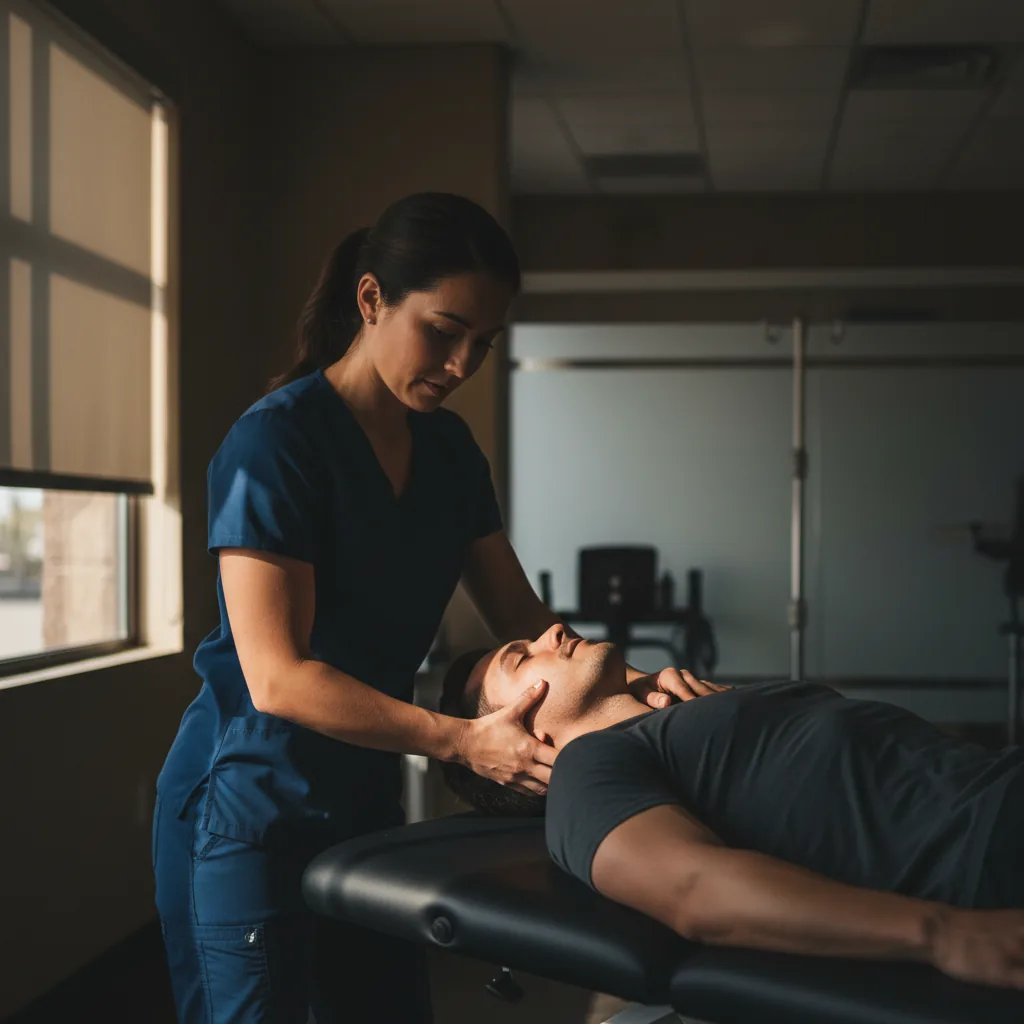
- Dr. Cisneros with you the entire session, every visit
- One patient at a time — full attention, every minute
- 45–60 minutes of hands-on assessment and treatment
- Treatment decisions based on your progress, not billing
- No artificial visit caps — you continue until you're better
- Cash-based: transparent pricing, no surprise bills
The research on this is consistent: patients who receive one-on-one care from a doctoral-level PT recover faster, require fewer total sessions, and have lower rates of re-injury than patients in high-volume shared-care models. When you're paying $60 per visit in co-pays and seeing a PT aide for 15 minutes, you are not getting physical therapy — you are getting supervised exercise.
Step 3: Match the PT to Your Condition
Physical therapy is not a one-size-fits-all field. The most effective PT for post-surgical ACL rehab is not necessarily the best choice for chronic neck pain or vestibular disorders. Before booking, ask directly: do you have specific experience treating [your condition]?
At Solas PT in El Paso, Dr. Cisneros focuses on:
Musculoskeletal & Orthopedic Conditions
Back pain, neck pain, shoulder injuries, rotator cuff, knee pain, hip pain, sciatica, IT band syndrome, patellofemoral pain — the full spectrum of movement-related pain conditions.
Dry Needling & Electrodry Needling
Trigger point dry needling for muscle pain, combined with TENS electrical stimulation through the needles for chronic or stubborn cases. One of the few El Paso clinics offering electrodry needling as a advanced technique.
Sports Injury & Return to Sport
Rehabilitation for runners, CrossFitters, cyclists, and recreational athletes — with a specific focus on returning to full activity, not just pain reduction.
Post-Surgical Rehabilitation
Rotator cuff repair, ACL reconstruction, total knee and hip replacement, spinal surgery — working in coordination with your surgical team's protocol.
Looking for a PT in El Paso?
You just read what to look for — Dr. Andrew checks every box. Doctoral-level, one-on-one, no aides, no referral required, same-week appointments. See for yourself.
Step 4: Know the Red Flags
These are the signs that the clinic you're considering prioritizes volume over outcomes. Any one of these is worth noting. Multiple together is reason to look elsewhere.
You're treated by a tech or aide, not the PT. In Texas, physical therapy treatment must be performed by or under the direct supervision of a licensed PT. "Under supervision" often means the PT is in the building with other patients. If you're paying for PT and not seeing a PT, ask why.
You're given a generic exercise printout at your first visit. Your first session should produce a specific diagnosis, a clear explanation of what's causing your pain, and exercises chosen for your individual presentation — not a laminated sheet that gets handed to every patient with back pain.
The PT can't explain why each exercise was chosen. Every exercise in a good PT program has a specific rationale tied to your diagnosis. If your therapist can't tell you what muscle is being targeted, why, and how it connects to your problem — the program isn't individualized.
You're not improving after 4–6 sessions. Progress should be measurable and noticeable within the first few weeks. If you're 6 sessions in and feel no different, either the diagnosis is wrong, the program isn't right for your condition, or both. A good PT re-evaluates when progress stalls — they don't just continue the same program indefinitely.
You can't get an appointment within a week. For musculoskeletal pain, delayed treatment consistently leads to longer recovery. If a clinic can't see you within 5–7 days, the pain cycle entrenches further and outcomes worsen. At Solas PT, same-week appointments are standard.
Solas PT checks every box on this list
Dr. Andrew Cisneros, PT, DPT, MS — one-on-one every session, 45–60 minutes, no aides, no double-booking. Certified in dry needling and electrodry needling. West El Paso. Same-week appointments. No referral needed. Cash-based with HSA/FSA accepted.
Step 5: Understand the True Cost
Insurance-based PT feels cheaper until you look at the actual numbers. Most El Paso patients with insurance face deductibles of $1,000–3,000 before coverage kicks in, co-pays of $30–60 per visit after that, and co-insurance of 20–30% on top. If you're in the deductible phase, you're paying full billed rates — which can be $150–250 per session at large clinic chains.
At Solas PT, we are cash-based. That means:
Transparent pricing before your first visit
You know exactly what each session costs before you book. No codes, no explanation of benefits letters weeks later, no surprise bills from out-of-network billing you didn't know was happening.
HSA and FSA accepted
Physical therapy is a qualified medical expense. You can pay with pre-tax dollars from your Health Savings Account or Flexible Spending Account, effectively reducing your cost by your marginal tax rate.
No referral required — ever
Texas direct access law means you can book directly without a physician visit first. No prior authorization delays, no referral paperwork, no waiting weeks for approval before starting treatment that should have started last week.
The math often surprises people: Many patients in the deductible phase of their insurance pay more out-of-pocket at an insurance-based clinic than they would at Solas PT — while receiving 15 minutes with a PT aide instead of 60 minutes one-on-one with Dr. Cisneros. Before assuming insurance means cheaper, run the actual numbers for your plan.
Dry needling when it's clinically appropriate — no insurance authorization required
This is one of the most overlooked advantages of cash-based PT. Most major insurance plans — including many employer plans and Medicare — classify dry needling as "experimental" or exclude it from covered services entirely. The result: even PT clinics with a certified dry needling therapist on staff often cannot perform it during your visit, because the insurance company will deny reimbursement. You may be told "we don't offer that" even when the therapist is fully trained and it would be the right treatment for your condition.
At Solas PT, there is no insurance company in the room. If Dr. Cisneros determines that dry needling — or electrodry needling with TENS electrical stimulation — is the right approach for your condition, he performs it. No prior authorization. No denial. No waiting. Your treatment is built around your body, not your benefit summary.
Questions to Ask Before You Book
Call any clinic you're considering and ask these directly. The answers will tell you everything you need to know about the care model.
"Who will be treating me — the PT or an aide?" The right answer: the PT, every session, the entire time.
"How many patients will my therapist be seeing at the same time as me?" The right answer: one — you.
"How long is each session?" The right answer: 45–60 minutes. Anything under 30 is a red flag.
"Do you offer dry needling? Is the person performing it certified?" The right answer: yes, and yes — with a named certification.
"Can I book without a referral?" In Texas the answer should be yes — direct access covers your first 30 consecutive calendar days, so any clinic telling you a referral is needed to get started is adding a step the law does not.
"What's the earliest available appointment?" Same week is appropriate for most musculoskeletal conditions.
Frequently Asked Questions
Prioritize one-on-one sessions with a DPT every visit, experience with your specific condition, same-week availability, transparent pricing, no referral requirement, and the availability of advanced techniques like dry needling if relevant to your condition. Ask directly who will be treating you — the PT or an aide — and how many patients they see simultaneously.
No. Texas is a direct access state — you can see a licensed physical therapist without a physician's referral. At Solas PT in West El Paso, Dr. Cisneros sees patients directly with no referral, no prior authorization, and no insurance involvement required. You can book today and start treatment this week.
A DPT (Doctor of Physical Therapy) holds a clinical doctorate — three additional years of graduate education after a bachelor's degree, including advanced diagnostics and 30+ weeks of clinical internships. All newly licensed PTs in Texas hold a DPT. Dr. Cisneros holds a PT, DPT, MS — a clinical doctorate plus an additional master's degree.
Insurance-based PT in El Paso typically costs $30–60 per visit in co-pays after your deductible is met — but if you're in the deductible phase, you may pay $150–250 per session at full billed rates. Cash-based PT at Solas PT is priced transparently and disclosed before your first visit, with no surprise billing. HSA and FSA funds are accepted. Many patients find the total cost comparable with significantly better care.
Yes — dry needling is one of the most effective treatments for sciatica in El Paso, particularly for piriformis syndrome where the piriformis muscle compresses the sciatic nerve. At Solas PT, Dr. Cisneros also offers electrodry needling with TENS electrical stimulation for chronic sciatic pain — a advanced technique not widely available in El Paso. Most sciatica patients see meaningful improvement within 2–4 sessions.
Solas PT offers completely one-on-one care — Dr. Cisneros is with you every minute of every session, seeing one patient at a time. It is cash-based with transparent pricing, no insurance billing, no referral required, and same-week appointments. Services include dry needling, electrodry needling with TENS through the needles, and nerve flossing. Located in West El Paso at 300 N Resler Dr, Ste F. Call or text (915) 318-7381.
Ready to Experience One-on-One PT in El Paso?
At Solas PT, Dr. Cisneros is with you every minute of every session. No aides. No shared treatment time. Same-week appointments available in West El Paso — no referral needed.
Book Your EvaluationDry Needling El Paso → | Sciatica Relief → | Transparent Pricing → | About Dr. Cisneros →